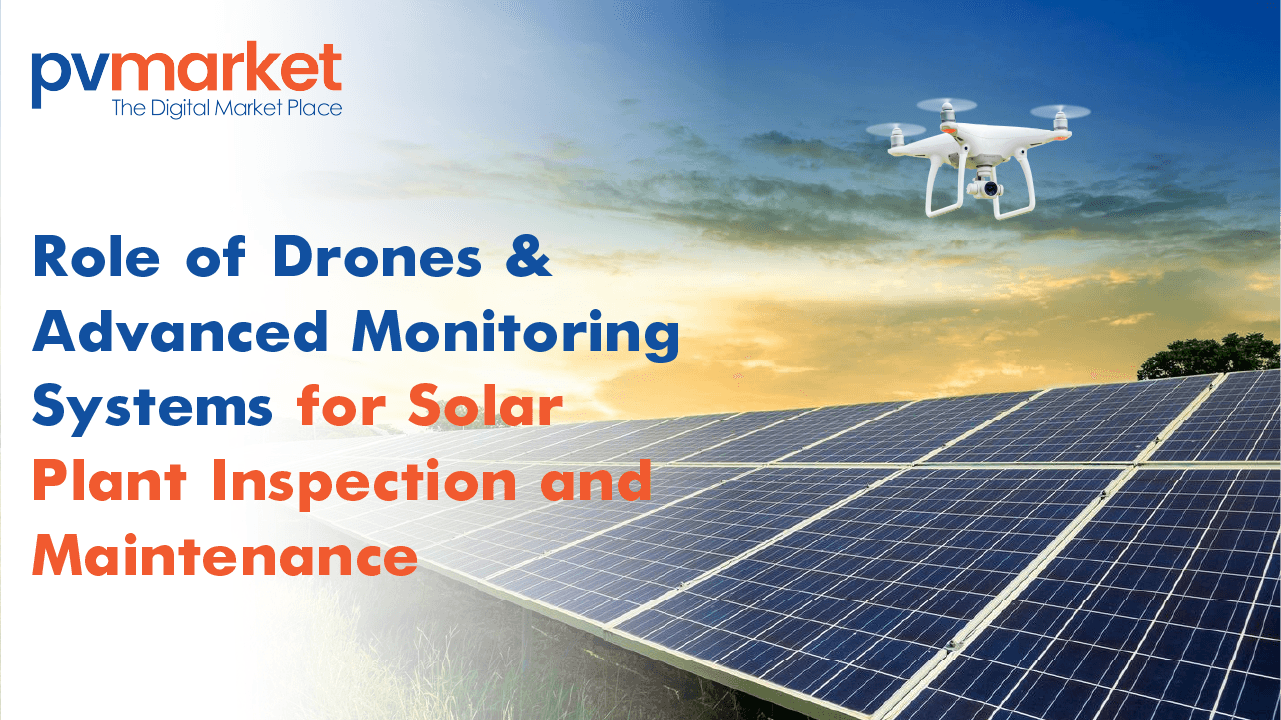
The Role of Drones and Advanced Monitoring Systems for Solar Plant Inspection and Maintenance
As global installed solar PV capacity
surpasses 1.6 TW in 2025, operations and maintenance (O&M) have
emerged as a strategic priority for utility-scale solar operators. With sites
often spanning several hundred hectares, manual inspection is no longer
viable. Drones and AI-powered monitoring systems are proving
indispensable in reducing downtime, improving energy yield, and cutting O&M
costs by up to 30%—a significant advantage as solar plants aim to
maintain profit margins amidst falling tariffs and tightening performance
guarantees.
Benefits of Drones and Monitoring
Systems in Solar Plants
1. Speed and Efficiency
A drone can inspect a 100 MW solar PV plant in under 2 days, compared to
7–10 days for manual crews. This slashes inspection labour costs by up
to 70%, cutting expenses from $15,000–$20,000 to just $3,000–$5,000
per round.
2. Increased Energy Yield
Faster detection of faults like hotspots and soiling boosts energy output by 1.5–3%
annually, equating to 1.5–3 GWh/year for a 100 MW plant, translating
into revenue gains of up to $150,000 annually at $0.05/kWh.
3. Enhanced Fault Detection
Drones using thermal, RGB, and multispectral cameras detect faults as
small as 2 cm², increasing fault detection accuracy by over 90%,
while reducing non-detection rates from 12% to below 2%.
4. Sustainability and ESG Alignment
Reduced vehicle trips and on-site labour lower CO₂ emissions by 20–30%,
supporting corporate sustainability commitments.
How Drones Improve Solar Panel
Inspections
Digital Twins & Predictive
Maintenance
Drones use photogrammetry to create digital twins of solar plants,
allowing for:
Real-time vegetation monitoring
- Panel tilt/misalignment detection
- Robotic cleaning route optimization
When integrated with AI-driven analytics,
these tools support predictive maintenance, reducing unplanned downtime
and equipment degradation.
Automated Defect Tagging
Drone platforms can geo-tag faults like:
- Hotspots
- Delamination
- Cracks and back sheet issues
Operators can act on this data within hours,
not days, ensuring same-day response versus 3–5-day delays under manual
workflows.
High-Resolution Imagery at Scale
Multispectral and thermal cameras provide:
- Temperature differentials within ±0.1°C
- Soiling rate detection with <2% reflectance deviation
- Panel-level granularity across >100 MW/day coverage
This level of detail helps asset owners
optimize plant performance with precision that ground teams simply cannot
match.
Drones in Solar Energy: Opportunities
and Challenges
Opportunities
- O&M Cost Reduction: Drones cut
costs by 25–30% annually through reduced labour, faster
inspections, and lower yield losses.
- Data-Driven Decision-Making: AI
platforms interpret terabytes of sensor data per month to refine
cleaning schedules, predict inverter failures, and extend asset life.
- Rapid Scaling: Drone systems can
inspect multi-gigawatt portfolios with minimal additional
resources, enabling cost-effective growth.
Challenges
- Initial Investment: High-end drone
systems with AI software can cost $25,000–$50,000+, which may be a
barrier for small operators.
- Regulatory Hurdles: Airspace
restrictions, drone pilot certifications, and data privacy laws vary by
country, limiting full automation.
- Data Management: Handling and
securing massive volumes of imagery and sensor data requires a robust IT
infrastructure and skilled personnel.
Manual Inspections: Costly and
Time-Consuming
In a typical 100 MW solar plant,
manual inspections can require:
- 8–10 technicians
- 7–10 days for full site coverage
- Costing around $15,000–$20,000 per inspection round
- Yield losses of 3–5% annually due to delayed fault
detection, equating to $150,000–$250,000/year in revenue losses
(based on $0.05/kWh tariff)
Such inefficiencies make traditional
methods unsustainable for today’s gigawatt-scale solar installations.
Drones: High-Speed, High-Resolution
Asset Insight
Speed and Cost Efficiency
- A drone can inspect 100 MW of solar PV in 1–2 days
- Labour costs drop to $3,000–$5,000 per inspection round
- ROI achieved within 12–18 months through energy gain and
O&M savings
Accuracy and Fault Detection
Drones equipped with thermal, RGB, and
multispectral cameras can detect:
- Hot spots as small as 2 cm²
- Soiling rates over modules with <2%
reflectance change
- Microcracks, delaminations, and back
sheet degradation
Studies show drones can increase fault
detection accuracy by >90% compared to ground crews and reduce
non-detection rates from 12% to below 2%.
Digital Twin Integration
Using photogrammetry, drones can generate 3d
digital twins of solar assets, which are used to:
- Monitor vegetation encroachment
- Track panel misalignment
- Plan robotic cleaning paths
Real-Time Monitoring: From Reactive to
Predictive O&M
Sensor-Driven Diagnostics
Advanced monitoring systems leverage IoT
devices such as:
- String-level sensors (voltage,
current, IV curves)
- Weather stations (irradiance,
ambient & panel temperature, wind)
- Soiling sensors (optical or
gravimetric)
These systems sample data every 1–5
seconds, producing terabytes of operational data monthly in
large-scale plants.
Performance Analytics
Platforms powered by machine learning
algorithms analyze:
- Panel degradation trends (typically 0.5–1.0%/year)
- Inverter anomaly predictions with >85% accuracy
- Optimal cleaning schedules, reducing water use by up to 60%
Case studies show that AI-based diagnostics
can increase annual energy output by 1.5–3%, equivalent to 1.5–3
GWh/year for a 100 MW site.
Case Study: 500 MW Solar Park,
Rajasthan, India (2024)
- Drone inspection time: Reduced from
10 days to 36 hours
- Faults detected: Increased by 22%
- Energy output improvement: 2.3%,
equating to ~11.5 GWh/year
- O&M savings: Estimated $120,000
annually
Environmental and Operational Benefits
|
Metric |
Traditional
O&M |
Drone
+ AI O&M |
|
Inspection
time |
7–10
days |
1–2
days |
|
Annual
energy loss |
3–5% |
<1.5% |
|
O&M
cost/MW/year |
$6,000–$8,000 |
$4,000–$5,000 |
|
Manual
labour requirement |
8–10
staff |
2–3
drone operators |
|
Fault
response time |
3–5
days |
Same-day
alerts |
Additionally, reduced vehicle usage and on-site human activity lowers CO₂
emissions from maintenance activities by 20–30%, supporting ESG
targets.
Outlook: Autonomous Inspection and Swarm
Drones
Emerging trends for 2025–2027 include:
- Docking stations for autonomous
drone charging and deployment
- Swarm drones for parallel
inspection of gigawatt-scale sites
- Integration with robotic cleaning fleets for automated
dispatch based on soiling levels
- Blockchain-based fault ledgers to
secure asset integrity records for insurers and investors
The global market for drone-based solar
inspection is projected to grow from $1.2 billion in 2024 to $4.7 billion by
2029, at a CAGR of 31%.
Conclusion
With solar plants increasing in size and
complexity, the shift toward drone-based inspections and AI-powered monitoring
is not just innovative—it’s essential. These technologies provide speed,
precision, and intelligence needed to maximize uptime and safeguard ROI. For
developers, IPPs, and O&M providers aiming to scale profitably, investing
in these tools offers a clear path to smarter solar operations.
Leave a Comment
Comments
No comments yet. Be the first to comment!